
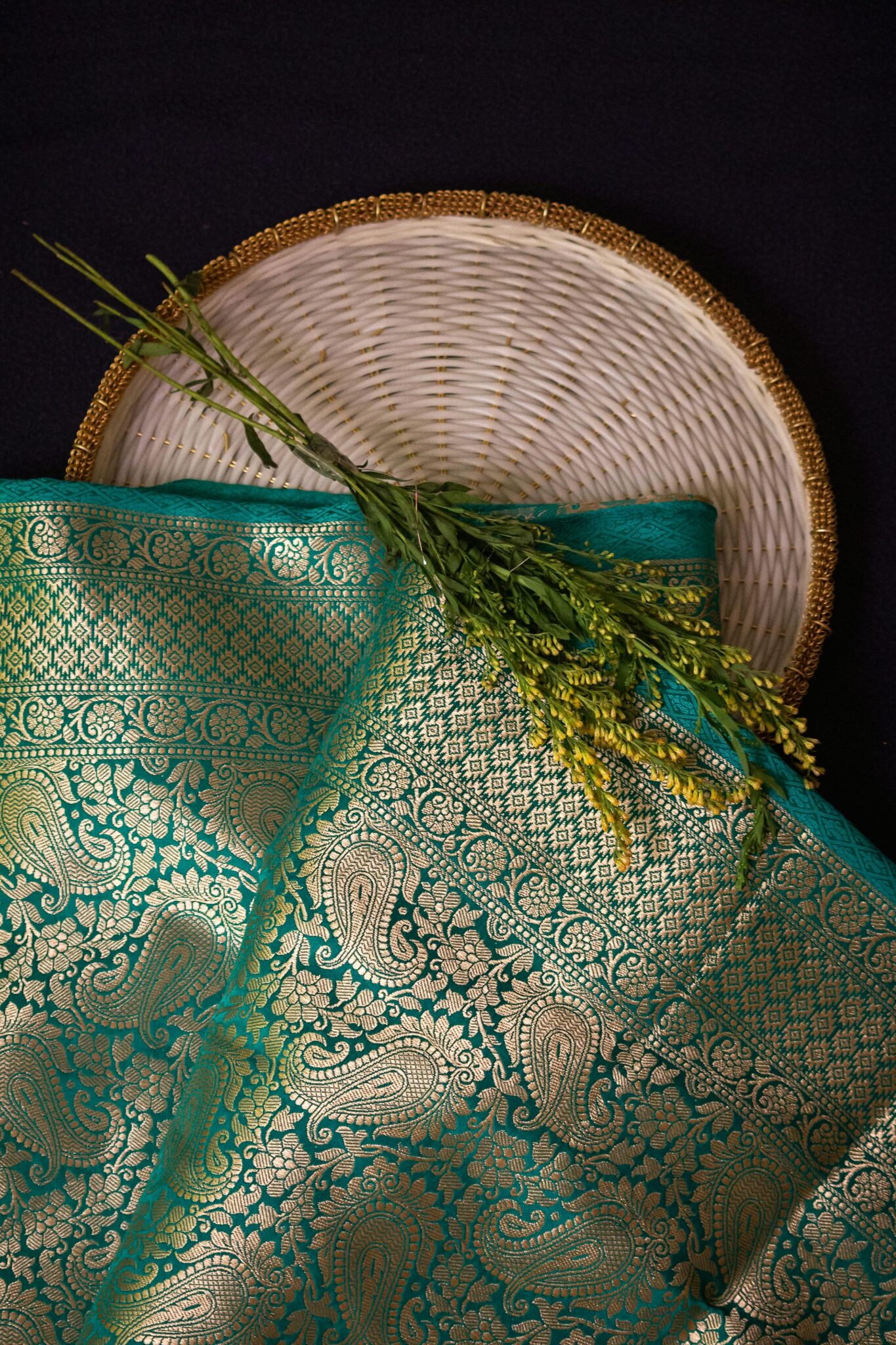
There are stories we tell out loud.
And then there are stories that never ask for words.
They stay folded.
I didn’t always know that sarees carried stories.
I only knew they carried weight.
As a child, I thought sarees were heavy because of the fabric.
Later, I understood they were heavy because of everything they had seen.
In my earliest memory, sarees existed at knee level.
Borders brushing against my shins.
Pallus swinging like quiet flags of authority.
Women moving around me, their lives wrapped tightly, gracefully, endlessly.
The house smelled of rice, soap, and sun-dried cotton.
Someone was always folding a saree.
Someone was always unfolding one.
I didn’t know then that I was watching history repeat itself, gently.
The Saree That Was Always There
My mother’s sarees were not special occasion garments.
They were daily companions.
They soaked sweat, tears, turmeric, and time.
They were worn while stirring boiling milk and breaking down silently.
They were present during arguments and apologies, festivals and ordinary afternoons.
Her sarees never asked for attention.
They existed the way she did — constantly, quietly.
There was one saree she wore when she sent me off to school.
Another when she waited for me at the window.
Another when she pretended not to cry at my farewell.
Different sarees.
Same strength.
I don’t remember her saying, “I am strong.”
But I remember her standing — always standing — pleats perfect, voice steady, heart tired.
That was my first lesson.
Strength doesn’t announce itself.
It wraps itself around responsibility and shows up anyway.
The First Saree
My first saree didn’t arrive ceremoniously.
There was no dramatic mirror moment.
No music playing in the background of my life.
It came folded, handed over casually, like something inevitable.
“Try it,” someone said.
And suddenly, the room felt quieter.
I remember the awkwardness.
The unfamiliar pull at my waist.
The fear of the pallu slipping.
The way my hands didn’t know where to rest.
I wasn’t wearing a saree.
I was learning how to carry myself differently.
That day, I didn’t feel beautiful.
I felt exposed.
Visible in a way I had never been before.
Later, I would understand —
that visibility is the first cost of becoming a woman.
The saree didn’t change my body.
It changed how the world looked at it.
Saraswati Puja and the Colour of Belonging
There is a particular smell to Saraswati Puja mornings.
Fresh flowers.
Cold floors.
Warm ironed sarees.
White with red borders.
White with yellow stories.
White holding centuries of prayer.
Women woke early those days.
They spoke softly, moved gently, as if even sound should respect learning.
I watched them drape those sarees like rituals.
Careful folds.
Sacred intentions.
Saraswati wasn’t just worshipped on those mornings.
She was worn.
In cotton and silk.
In calm faces and nervous students.
In mothers who prayed not just for marks, but for resilience.
Those sarees didn’t sparkle.
They didn’t try to be fashionable.
They carried devotion the way only simplicity can.
Even now, whenever I see a white saree with a red border, something inside me bows.
Different Sarees, Same Woman
As I grew older, I met sarees beyond my home.
The crisp authority of a cotton saree worn to work.
The softness of silk on wedding days.
The rebellion of pairing tradition with new confidence.
Each saree brought out a different version of me.
One made me feel rooted.
One made me feel powerful.
One made me feel vulnerable.
One made me feel like I was carrying generations on my shoulders.
The world often treats sarees as symbols of tradition — static, old, unchanging.
But sarees evolve with us.
They see us fall in love.
They see us fail.
They see us start again.
No fast fashion garment does that.
The Saree and the Goodbye
Every important goodbye in my life has involved a saree.
The saree my mother wore when I left home.
The saree my aunt wore at the train station, pretending it was just another visit.
Sarees know how to say goodbye without words.
They absorb tears without complaint.
They crease where hands clench.
They remember hugs longer than people do.
Once, while folding an old saree, I found a faint stain near the edge.
I couldn’t place it.
Then I remembered —
a goodbye hug.
A rushed departure.
A moment no one photographed.
Some memories don’t live in albums.
They live in fabric.
The Weavers We Don’t See
Behind every saree I have worn, there has been a hand I never met.
A weaver waking before dawn.
A family passing skill through muscle memory.
A loom singing patience into thread.
When I think of sarees now, I think of time.
Time taken to grow cotton.
Time taken to dye yarn.
Time taken to weave patterns that don’t rush.
Sarees teach us something we are forgetting.
That slowness is not inefficiency.
It is care.
That not everything needs to be replaced.
Some things need to be preserved.
When a saree disappears, a language disappears with it.
Why These Stories Matter Now
We live in an age of quick choices.
Swipe, buy, discard.
Wear once, forget.
Sarees don’t belong to this rhythm.
They ask for patience.
They ask for presence.
They ask you to feel.
Maybe that’s why they are slowly disappearing from everyday life.
Not because they are outdated —
but because they demand more than convenience.
They demand connection.
And connection takes effort.
Why I Created Zarikatha
Zarikatha was born out of fear.
The fear that these stories would disappear quietly.
That sarees would become costumes, not companions.
That memory would be replaced by trend.
I didn’t want to write about sarees as objects.
I wanted to write about what they hold.
Zarikatha exists to collect what doesn’t fit into captions.
The saree worn on the first day of teaching.
The saree worn after loss.
The saree passed down without explanation.
Here, we remember.
Here, we slow down.
Here, we let fabric speak.
Between the Pleats
Every saree has a place it hides things.
Between pleats.
Near the edge.
At the border where fingers fidget.
That’s where the stories live.
Not in grand gestures.
But in everyday survival.
If you’ve ever held onto your mother’s pallu in a crowd.
If you’ve ever adjusted your saree before facing the world.
If you’ve ever folded a saree carefully because it held too much —
You already belong here.
Zarikatha is not about nostalgia alone.
It is about recognition.
Recognising ourselves in what we wear.
Recognising strength in softness.
Recognising that some stories are not loud, but they last.
And if you listen closely —
you’ll hear them.
Between the pleats.